Here we go…
Be yourself; Everyone else is already taken.
— Oscar Wilde.
This is the first post on my new blog. I’m just getting this new blog going, so stay tuned for more. Subscribe below to get notified when I post new updates.
Everything about drones

Be yourself; Everyone else is already taken.
— Oscar Wilde.
This is the first post on my new blog. I’m just getting this new blog going, so stay tuned for more. Subscribe below to get notified when I post new updates.

Welcome to dystopia. What once seemed to be remote events have now come close to us all. What once merely affected the delivery dates of my new drone, has now resulted in more local manifestations; my ski season was cancelled early, the resorts forced to close again their (and our) will. Our right to peaceably assemble has been suspended…for ‘our own safety’. (I somehow thought the Bill of Rights was meant to protect our rights in times of disaster, when we really need them. Silly me).
So, here we are, virtually ordered to practice social distancing (not interacting with our fellow humans, in this time of uncertainty and fear). We are told to stay home, and never mind the family fiances. So what’s a good citizen to do? What’s a remote pilot to do?
Should I hunker down in fear, avoiding my fellow human and patting myself on the back for my efforts to prevent the spread of a disease that has killed less than alcohol or flu? Should I shake my fist at the authorities and carry on like normal, whistling past the grave like usual? I want to be a responsible citizen, after all, but not a blind sheep.
Again, what’s a person to do?
I think I will carry on doing a lot of what I do normally, such as:
-Help people if and when I can
-Try not to harm or disrespect people
-Add to the positivity, instead of the negativity
and, perhaps most importantly of all….
Fly my drone.
Ride my motorcycle out to fly my drone.
Hike up the mountain to fly my drone.
All the above, added to remembering to enjoy the spring, to not let a nebulous fear of events I can not foresee or change ruin my spring.
Yep, that’s what I’ll do.
When I’m out flying, I am already ‘socially distanced’, since I am out in nature, away from people.
I know I’m not spreading (or getting) disease, since all I’m touching is my remote control and the stuff in my pack. (I don’t go around fondling Nature).
For I think what we all need is to get away for a moment, to do something we enjoy..to get out in nature, where we can get a little shift in perspective.
Yeah, fly my drone. That’s the ticket.
Look, I feel like my time flying legally is limited, anyhow. Within three years the FAA will effectively put the kibosh on free flying in the Land of the (formerly) Free. So, I’m not likely to let many things (aside from rain, sleet, hail, and high winds) stop me from flying in the precious little time I have left.
I think the world would rather have a me fresh back from flying, a smile on my face, than they would have a me who is pale and wracked with cabin fever, one who has been immersed in the stormcrow ravings and disaster propagating media. (You can sell a lot of beer and cornflakes with chaos and confusion). (Ratings love a disaster).
I feel that disasters faced together are better handled than disasters faced alone.
We can fly together, and still do it safely, still be socially responsible. We can decline the invitation if we have a fever. We can go if we don’t, and maintain a bit of safe space, if nothing else, then to keep those with us in their comfort zones. We can forgo the normal hugs and handshakes. We can turn away and cough into the crook of our elbows, if we have to cough.
But we can still fly together. Heck, if we’re really worried, we can place a ten foot safety buffer between us as we fly, and yell and smile across that distance.
I discovered a few things in my relatively long life. One of them is this;
-Circumstances can’t beat you. Only YOU can give up. Those circumstances may grind you into a muddy and bloody spot on the planet, but only we can give up and give in. Only we can decide to quit. We can hunker down, fearing all the many things that could conceivably ruin our day
So me, I’ll fly.
Yeah, I’ll wash my hands. I’ll avoid large gatherings and even play along with the social distancing bit, to a degree. I won’t protest at the suspension of our right to assemble, for I don’t think we need protests and gatherings just now (aside from them required for us to fly and to celebrate spring sensibly).
So, for the duration, you know where you can find me (when the weather is good enough to fly or hike, which is always)…I’ll be out flying. Riding. Hiking. Mostly alone. But one thing I won’t be doing is huddling inside, in fear.
Sure, many times I will be at home; after all, I need to charge my batteries, and write these blogs, and figure out this apparent ESC problem I have on my cine-whoop. Oh yeah, and uploading pictures of the world outside…a reminder to the home-bound that the world still exists outside, that it is blooming, and it carries on, with us or without us.
So, I wish you the best during these trying times. I wish safety and health, prosperity and peace to you and yours.
Oh yeah, I also wish you lots of time flying…
…experiencing the miraculous gift of a bird’s eye view, while it is still ‘allowed’ to us.
Be well.
Fly.
Keep your spirits up; for even the worst disasters, we eventually reach ‘the other side’. We want to make sure we meet that other side as healthy, happy, and sane as we possibly can..the future might need us…
…to rebuild, to help, to get back to normal…
…to fly.

I sure love flying drones.
I started flying a ‘camera drone’…mass-produced, for the masses. As such, the ‘rates’ of control were turned way down, to make it docile and ‘cinematography’ compatible.
These Every-man drones have three basic modes: C or cinematography, P or position, and S or sport mode. Each mode has progressively higher rates, speed, and performance. The best I had available with these type of drones was the good ole ‘S mode’, and it was (to the relatively new pilot I still am) plenty zippy.
But after a while I got used to it, and it began to seem downright pokey, compared to the performance I saw posted in the aerobatic and racing forum videos. I wanted more.
Besides, those camera drones flew mostly in 2-D. Well, they flew in a sort-of 3-D, definitely much better than a car or motorcycle. You could (after all) go up and down, in addition to zipping side to side, and through turns. It was the basic definition of 3-D movement, and when I first started, it was epic, liberating, even transformational. But you couldn’t do barrel rolls or flips, no vertical dives or swooping ascent turns. No power rolls or yaw spins. I wanted more. I wanted real 3-D.
This was all before considering thrust to weight ratio (TWR). Those camera drones had maybe 2:1 to 4:1 TWR, and that seemed pretty zippy, at first. Of course, the weight had to be fairly high, carrying around GPS receivers and cameras and gimbals. And the big manufacturers weren’t throwing in some extra thrust to make up for that weight…they knew their market. The folks who were buying these camera drones (selling like hotcakes, by the way) wanted good video…which meant a stable aerial platform…which meant a slightly under-powered (and maybe even docile) drone, with a low TWR. It meant an easy-to-fly drone, a ‘stabilized’ drone. I wanted more.
So I got more. I watched a couple hundred videos and listened to a couple hundred reviews and comparisons. I studied facts and figures, compared motors and camera and components. Finally I chose; a great little drone, one of the type they call a cine-whoop, and the best of that bunch. It was called ‘cine’ because it has a High Definition camera, so it was sort of cinematographic. It was called ‘whoop’ because it is a sporty little thing, able to zip around so fast it would elicit a ‘whoop’ of delight from the pilot.
I tested everything, configured it and checked it out on the bench, and finally proclaimed it ready to fly. Oh, sure I had heard the advice that it was better to spend some time in the simulator, crashing fake drones, than it was to spend time in the field, crashing your own actual drone (and throwing away hard-earned money in the bargain). But my laptop was almost maxed out in memory, and probably a little weak in GPU power to run a simulator.
So, rather than get dragged further into the 21st century and getting an appropriate laptop (I’d already spent a ton of money on drones and peripherals), I decided that…well, heck, I was a pretty good pilot and A) I could pilot the heck out of my Mavic, so B) I could pilot this new cine-whoop, if I just took it slow and started out line-of-sight in a big field somewhere.
Now they say a mark of a good pilot is to be able to form an unbiased and accurate sense of their own skills, abilities, and shortcomings. They say a good pilot exhibits and practices good ADM (Aeronautical decision-making) skills. I figured I was a good pilot. I also figured I could ignore the advice of a majority of good pilots and skip the whole simulator bit.
After all, I ‘reasoned’, it was a nice day (albeit a bit windy). I figured I was in a pretty big field, and pretty much sheltered from the steady and gusting wind. I reckoned I’d be okay, and I was more than enough of a pilot to handle this mission.
So I prepped. I checked the area and the aircraft. I self-evaluated. I double-checked my equipment and reviewed my basic flight plan. That plan was to fly line of sight for a battery (or maybe even two) and get the feel of this new aircraft, before putting on the FPV goggles (as I was dying to) and rip around like an osprey, marveling at the new eagle eye view I had.
Yeah, I thought (mentally patting myself on the back), that would be a great plan. I was a real sport, knowing I needed to chill a bit and having the discipline to back it off like I did by going LOS (line of sight). I was a great pilot, with a great plan. What a guy.
Well, I did my checks, and spun up the props, and hit the ‘up’ lever a little bit, to get the aircraft hovering at around six feet…
…Well, faster than (insert incredibly fast metaphor/analogy here), that drone was up in the clouds. I mean that sucker just took off. God knows what would have happened if I’d have moved that lever a little more, or (God forbid) to the stops. As it was, that sucker took off like the price of Marlboros in a crisis. I mean, that baby was gone in two point two milliseconds. Gone, I say.
Did I mention it has a TWR of 6:1? Yeah, six times as much thrust (lifting up) as it had weight (pushing down). Saints preserve us! That thing moved out like it was late for a wedding. Now, the difference between 3:1 and 6:1 doesn’t seem like much…sitting here in the living room, or thinking about it in general terms. But in practical reality, it is worlds of difference. I mean, that baby took off…did I say that already?
Before you know it, a big gust of wind (and my fingers probably dead on the levers, as I gawked in amazement) took my little whoop up over the rooftops and headed towards…people. People out of my line of sight. That is not a good thing. That is not a legal thing. So, like the good citizen I am, I reached for the disarm switch, to let that baby go brick mode, rather than have it fly halfway to China and land God-knows-where.
Well, on my way to the brick mode switch (the disarm switch), my finger brushed the automatic roll switch programmed into my controller (not by me; I wanted that switch to be for something innocuous like a buzzer, and thought I set it like that).
Well, once I hit that roll switch, that little drone did a series of impressive rolls on its way toward terra firma. It was rolling as it went behind the intervening building, as my finger finally hit the disarm switch, to force it into a brick-mode landing.
I gotta admit, the suspense was high as I ran to the other side of the building. What if it was crashed on top of a nice Corvette, smashed to smithereens as it made a huge dent in the ‘Vette’s hood? What if it was laying next to a knocked-out kid? Oh, the what-ifs ran through my head as I raced over there, expecting to see…something.
Well, all I saw was nothing. A couple guys stood near where I figured it had landed, looking too casual (and not-mad) to have had a drone barrel-roll to the Earth, inches from them.
Well, the rest is anti-climax. I searched the roofs and bushes near the area I thought it had landed. I cursed myself (briefly) for not putting a GPS locator on the drone (my fixation with TWR kept me from doing it). I looked and looked…and found nothing. I widened my search. Still nothing.
I met a nice guy who lived nearby, and told him my sad story. He walked with me as I searched. When I went further away (thinking to widen my circle), he volunteered to look the other way. Well, I had just about resigned myself to having lost my new drone on its first flight, when some guy came and told me the other guy had found my drone.
The suspense was killing me…in pieces? Flown half-through a window?
But no, it was fine…not a durn dent or scratch on it (pretty impressive for going at speed into the Earth, from an estimated forty feet).
Well, I was sure glad to see it, and having already eaten a lot of humble pie, ate some more as I re-evaluated my decision-making and flying skills. So, rather than rush right back out into the windy field and try again, I decided to bring Baby home and review my rates and PIDs, maybe dial my tune down a bit.
Well, I know we are remote pilots, and anything that happens to our aircraft doesn’t really happen to us, but once I got back, I discovered I felt as if I had been through a crash…as if I had been found and saved, instead of my unmanned drone.
So here I sit, taking a break from watching (yet more) videos about rates and PIDs and tuning drones. Here I sit, with a belly full of humble pie, and a heart full of thankfulness, that I didn’t lose or destroy my drone.
Daaaang. I mean that baby took off.
This is an entirely different world than camera drones.
I want more.
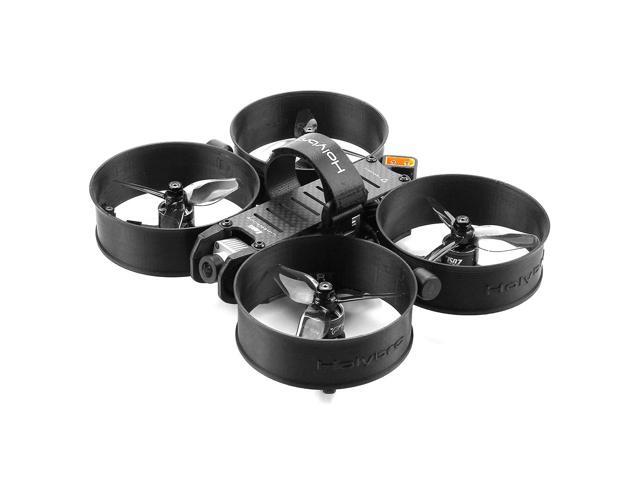
Type: 3-S/4-S, 3”Mini-Quad, Short Range, Short Endurance (SRSE)
Fuselage: Unibody, modified X-frame with attached propeller ducts,
3mm 3K carbon fiber (186g with ducts)
Dimensions: (L x W x H) 178 x 205 x 40 mm (7.01 x 8.07 x 1.57”)
Wheelbase: 148.6 mm (5.85”)
Battery Type: 3 or 4-S (650-1300mAh) Tattu R-Line V3.0 1300mAh 14.8V
120C 4S1 Weight(±20g): 150g,
(L x W x H) 77mm x 38.5mm x 27mm (3.03 x 1.52 x 1.06”)
Weight (‘dry’): 274 grams (9.66 oz., 43.15 milli-stones/0.00431476 stone)
Weight w. options: 289 grams, with GPS Sensor RDQ BN-880 and Lumenier
Taillight LED
Weight w. battery: 414g, with Tattu R-Line 4-S, 1300mAh
All-Up Weight: 439g, with battery, GPS, LED
Payload Weight: 565g, with battery, GPS, LED, GoPro Hero 7- 555g with battery,
GPS, LED, Hero 8
Total Thrust (Max) 2324g (2.324kg)
Thrust-Weight Ratio: 8.4:1 ‘dry’ (w/o battery), 5.6:1 (4-S 1300mAh battery), 5.29:1
(options + battery)
4.11:1 GoPro Hero 7, mount, and battery, 4.19:1 GoPro, mount,
battery, options
Max Airspeed: TBD
Service Ceiling: UNK
Endurance: TBD (Approximately 8 minute max)
Range: Approximately XXkm
Motors: 4 x T-Motor F1507, 3800Kv (581g thrust, 326W per motor at
2000usec ESC command)
Propellers: 4 x T-Motor T3140 tri-blade, bullnose (3.1 x 4.0 x 3) 3.1” disk,
4” pitch (ducted)
ESC Control: Tekko STM-32 F3 MCU, 4 in 1 mini-ESC (45A)
30 x 36mm Board, 20 x 20mm holes, 7.8g, BlHeli32 firmware
Flight Control: Kakute F7 HDV: STM-32 F745 (32-bit RISC)
35 x 35mm board, 30 x 30mm holes, 8g
SPI MPU6000 IMU Coriolis effect 3-axis gyro (16-bit
ADC@8KHz), 3-axis accelerometer, 10-DOF motion processor
BMP 280 Barometer, piezo-resistive effect
pressure/temperature sensor
Optional Sensors: GPS Receiver Holybro M8N 38x38x11mm, 20.6g
Magnetometer (3-axis compass)+ GPS RDQ BN-880
28x28x10mm, 10g
Barometer/Altitude Sensor
Optional Payload: GoPro Mount XXX
GoPro Hero7 126g (with battery Hero 8 116g
(with battery)
LED Strip Lumenier Tail Light: 35mm x 35mm x 5mm (1.38 x
1.38 x 0.2”), 5g
vTX/Transceiver: DJI Air Unit (vTX, C2 RX, DVR)
FH-SSMA, TDD
45.8 g (plus 7.8g for 2x MMCX adaptors) = 53.6g total
44 × 37.8 × 14.4mm (1.73 x 1.49 x 0.57”)
HDV Camera: DJI CMOS
27.4 × 21.1 × 20.1mm (1.08 x 0.83 x 0.79”)
Note: DJI includes camera weight in Air Unit weight (above)
Radio Remote: DJI FPV Remote
Notes:
FAA Docket 2019-1038 Type Certification of UAS as a special class of aircraft under 14CFR21.17(b)
M Mullen comments, page 1 of 2
I request the FAA define the intended certification types, methods, and timeline more thoroughly before making a ruling on Type Certification. The widely-varying types and uses of UAS make one blanket type of certification meaningless (or at best, ineffective). I propose in the alternative (if the FAA does decide for type certification) that type certifications be made by class of UAS and application, in a similar (or related) manner as manned aircraft.
Delivery UAS have different flight characteristics than recreational ‘camera’ UAS or FPV UAS. Thus, the technical and aviation requirements would need to differ, as well. Due to the sporadic, short-range and short-term nature of recreational UAS flight, the impact on public safety (and thus potential flight worthiness requirements) would vary considerably from ‘delivery’ UAS, which would exhibit longer flight times, different flight characteristics, and different numbers of aircraft in the NAS at any given time.
Even among recreational UAS, there is a wide range of applications and uses, which would require differing considerations of what constitutes airworthiness. Some key issues an airworthiness evaluation (in regards to recreational uses) might address are:
Differences in amateur-built and off-the-shelf applications
Differences between LOS-based UAS, virtual FPV (First-Person View) UAS, and FPV UAS
Note the current technology allows a remote pilot easily as much (if not more) airspace awareness as manned aircraft do; the visual range of an FPV UAS exceeds that of a pilot in a closed canopy/closed cockpit flight configuration.
Thus, the former restrictions requiring VLOS might reasonably be reconsidered
If given the resources of my fellow pilot from Ball University (who commented for VLOS requirements for all UAS), I am confident I could easily prove this in an empirical, scientific, facts and evidence-based set of tests
Differences between autonomous systems and remote pilot (human) systems
I would ask the FAA consider the large difference between delivery UAS carrying a payload and a recreational UAS (or an emergency services UAS with no payload but specialized sensors, etc.). The airworthiness criteria would (by necessity) vary considerably.
Finally, I would ask the FAA to consider whether recreational UAS should be classified as ‘other’ or ‘special’ type aircraft at all. The limited range and endurance of such aircraft (as well as current operational constraints specified already by the FAA) make their impact on and presence in the NAS small enough that no extra regulation or specification seems to be indicated.
FAA Docket 2019-1038 Type Certification of UAS as a special class of aircraft under 14CFR21.17(b)
M Mullen comments, page 2 of 2
I agree fully that (given the numbers of projected flights and the fact they are carrying payload) commercial delivery UAS should be classified and authorized by type. I would suggest this classification be based not on projected technologies, emerging or developing technologies, but by demonstration of actual, currently operational technologies.
The FAA cannot be expected to evaluate or classify aircraft based on notional technologies. If the commercial carriers wish to enter the NAS, they should be required to demonstrate functionality and to submit only tested and proven systems for FAA evaluation and consideration.
Finally, I respectfully request the FAA extend the comment period, and defer making a decision until receiving more input from all stakeholders, including recreational and small business pilots. The open comment period for 2019-1100 (Remote ID and Tracking of UAS) has prevented many pilots from commenting, as they are currently focused on NPRM 2019-1100.
Thank you for your time and consideration in providing me the opportunity to comment, and thank you for your service in attempting to promote equitable, fair rules and regulations which consider all stakeholders. Regards,

Response to FAA Docket 2019-1100 (Remote ID NPRM)
Hello
I am writing in response to the FAA NPRM for Remote UAS ID (Docket # 2019-1100). I am a U.S. citizen, a veteran, and a UAS pilot, and would like to address some issues and concerns I had when reading the NPRM, as well as provide some suggested alternative solutions. Thank you for providing the opportunity to do so.
The UAS Remote ID (and Tracking) proposal appears to be based on two valid concerns; NAS safety and NAS security. I would like to address how (for each category) the proposed NPRM could potentially cause more safety and security issues than it solves. I would also like to concurrently suggest some methods which might suit the FAA’s goals and objectives in a better manner than the proposed NPRM does.
Use of UAV as a reconnaissance tool for various outdoor activities can help increase safety, by improved awareness of the route ahead, and identification of possible hazards. This use could serve to reduce the number of accidents, and associated search and rescue costs
Use of UAV for personal safety, for example by joggers at night or in potentially dangerous places, can increase personal safety by acting as a deterrent. UAS which autonomously follows citizens (at a low altitude) and provide warning light or siren (panic button) and emergency calling services could potentially prevent many types of personal, violent crime, such as robbery, rape, or assault
Use of UAS to inspect a homeowner’s premises without exposing one’s self to danger (ladders and power lines, for example) or the elements (winter ice, etc.) can markedly increase safety at home.
Under the NPRM, these UAV-derived benefits to citizens (among others yet imagined or implemented) would be illegal. As such, it would deprive the public a method for improving personal (and neighborhood) safety, and thus the overall safety of society.
The rules proposed under the NPRM would negatively impact and affect the overall national security, at the national, regional, and local levels.
If UAS rules and regulations (and operational price) increase, the UAS technology and benefit will not begin to expand to include the general public.
One of the best monitoring and surveillance tools available to law enforcement and national security agencies is the well-intentioned, law-abiding citizen with an awareness of the local neighborhood and region. Their ability to identify possible threats or suspicious activities, and to provide law enforcement with actual evidence and documentation of illegal activities (as opposed to mere eyewitness accounts, most of which are not admissible, positive, or legally valid as documented evidence) would be severely reduced or eliminated under the proposed rules of the NPRM.
In the event of regional or national disaster, citizen-flown UAS can provide authorities an increased amount of real-time surveillance, assist in providing positive identification of threats and conditions, and increase resources available to disaster response teams and incident commanders.
Note the designation of certain groups for limited access to the NAS effectively outlaws members of those groups, creating outlaws from what were once basically honest citizens. The cost for enforcing such exclusionary laws would have a large impact on the A) national budget B) constraints under which the national security and law enforcement organizations already operate, and C) make distinction between ordinarily honest citizens disobeying exclusionary laws and ‘bad actors’ (with no love or respect for the United States, its laws, or aviation in general) difficult at best.
The effects of draconian laws (targeting specific groups of individuals) on national cohesiveness, the economy, and social issues too numerous to define can be seen by the US ‘war on drugs’, or prohibition on alcohol, which have taken such a high toll and resulted in such a high national cost, both in health, money, and law enforcement resources. Any time in our national history where we have targeted a distinct group of citizens, the results have been bad and the associated costs high.
By segregating the NAS (or at least high-density population areas and projected delivery routes) much of the potential for airspace contention and collision would be avoided.
Dedicating such segregated airspace would require re-definition of airspace (a task well within the capabilities and purview of the FAA, and one easily accomplished).
By segregating a portion of the existing airspace (and an additional component), the altitudes between (for example) 300 and 500’ AGL could be reserved for UAS delivery routes. The airspace between 0 and 300’ AGL could be dedicated for recreational UAS, and for commercial and emergency UAS services which require access to such space. This would leave only vertical corridors to and from launch and delivery sites as potential areas of contention.
The vertical corridors for launch and landing of delivery UAS could be negotiated by a number of techniques, among them:
TFR (Temporary Flight Restriction) could be activated just prior to use of the intended vertical delivery corridor
Advisory signaling from delivery craft prior to ascent or descent from these corridors could be sent either electronically, visually, audibly, or a combination of techniques, as deemed appropriate for the intended corridor
Real-time (or NRT) location of delivery UAS, through a mechanism similar to Flight Aware, could be available to all recreational pilots, or even consolidated into their flight control display (as advisories) or flight control system (as temporary or permanent ‘geo-fences’)
Limiting the Remote ID and Tracking of UAS to high population density areas and to potential delivery routes for commercial UAS would serve the FAA’s safety goals and still allow access to a large portion of the NAS for more limited commercial and ongoing recreational UAS flight operations.
Using only the broadcast ID technique would A) ease and accelerate implementation, as it could be accomplished relatively easily, B) have the added benefit of integrating existing UAS into the Remote ID ‘ecosystem’
The effective implementation of Remote ID does not necessarily imply global implementation. I suggest that due to the varied airspace conditions within each type of TLA (Technology Level Area, as defined by NASA), various implementations of Remote ID could be safely and effectively implemented.
In rural areas where little air traffic exists in Class G airspace, no planned commercial UAS (CUAS) delivery routes exist, are planned (or are likely), there is little reason to regulate or restrict recreational UAS flight.
The proposed Drone Zoning and Integration Act (proposed by Senator Mike Lee) define a two-hundred foot limit to personal property. To some parties (apparently including Senator Lee and his staff), this would provide a sense of security, and extend the homeowner’s ‘rights’ further into national airspace (a domain reserved to the FAA). Some see it as the freedom to either exclude drones from some areas and properties, while others see it as a way to allow drones in certain areas.
Either way, this is contradictory to FAA airspace zoning and control. However, in addition to segmenting airspace for (primarily) commercial and recreational usage, the FAA could also choose to designate the space between (for example) average treetop altitude and one hundred foot AGL (for example) as primarily dedicated for sports UAS. These systems operate primarily at lower altitudes, and present no privacy or safety issues with home and property owners. This allows ‘camera drones’ to be used in their optimum range of altitudes of one hundred to three hundred foot AGL. This altitude is removed enough that even with the best camera technology, the perceived ‘privacy’ and the fear of unwanted surveillance is reduced to the point of non-existence.
Again, basic airspace layer segregation would increase safety by reducing the possibilities for airborne collisions and space contention between commercial, recreational, and sport UAS. Of course, in the end the airspace would be shared by all and contention issues would need to be dealt with, as more experiential data is accrued and as applicable emerging technologies become well-tested and available.
As it stands, the NPRM proposes a very expensive means of implementation, with high costs to the FAA, the remote pilot, and society (and based on technologies which do not currently exist in an operational state). This works against the FAA goals of implementing solutions which can be quickly and easily activated. ‘Off the shelf’ methods of Remote ID are currently available at low or little cost, and are easy to implement.
The NPRM proposes a solution based on ‘vaporware’; technology which is anticipated to exist soon, or is under (costly) development. Setting standards based on technology and applications which do not currently exist merely obfuscates the issue, serves to delay implementation, and is counter to the FAA goals of timely and cost-effective implementation.
To propose a ‘billion dollar solution’ which may become reality at some future date over a cost-effective solution which currently exists both opposes the FAA goals and has an additional negative, in that implementation of such ‘solutions’ serves to increase public perception that A) the FAA is inept B) the FAA is ‘under the thumb’ of Big Business and merely facilitating their goals and C) that the FAA somehow has malicious intent in this…all untrue (as far as I can tell), but all would be easily adopted viewpoints given the circumstances. Perception of the FAA as an unfair actor who has the interests of big business over the safety of the NAS and the welfare of pilots only serves to reduce FAA effectiveness, by making them seem a ‘public enemy.’
The immediacy ascribed to this NPRM is felt only by the multinational corporations who stand to make huge profits by quickly implementing UAS-based delivery services in our NAS. I would suggest it behooves the FAA, the wider UAS pilot population, and the nation in general to take adequate time to fully consider the issues and alternatives more fully, and implement them in stages, as the technology and techniques become available and are sufficiently tested for integration into the NAS.
Using the United States NAS as a ‘test bed’ for implementation of commercial profit-making schemes does not serve national security, aircraft safety, or good common sense. Thus, I suggest the following:
a. Allow the proposed methods to be tested elsewhere, while the FAA evaluates the effect and advisability of such proposed money-making schemes on the NAS
b. Institute a moratorium on further regulation-making, until a public meeting can be held to discuss and evaluate the issue in more depth, with all stakeholders represented.
Include the UAS recreational pilots in the dialogue (both legacy RC pilots, FPV/Racing pilots, and recreational ‘camera drone’ pilots)
The negative impact to society from the proposed NPRM may be felt most at the financial and operational levels by the FAA itself and to any involved law enforcement or national security agencies.
Laws, rules, and regulations which are understood by and accepted by the general public require little or no enforcement. Rules which are perceived as draconian, useless, or unfair are generally ignored by the public, and thus require extensive enforcement.
With these enforcement efforts are associated high costs in time, effort, and capital. In addition, it places the focus of law enforcement authorities away from more imperative and time-sensitive matters, and diverts that focus onto less critical issues and objectives.
While the FAA’s intentions are to provide well-reasoned, clearly-stated and obviously-needed regulations which consider the interests and rights of all stakeholders, the implementation of this NPRM would result in either the actuality or appearance of unfairness, bias, and illegality.
When a large number of corporations stand to profit from a ruling, while the same ruling results in financial cost and hardship on the general public, the ruling appears biased, and presents the impression of unfairness. When the interests of large corporations are advanced over the interests of the general public, that perception is increased.
With implementation of this NPRM, a clear message would be sent to the public that this very thing has become a reality; that the recreational pilot has been ‘pushed out’ of the skies in favor of large corporate delivery services which provide limited and questionable benefits to society.
Regarding aviation, when one group of pilots receives different treatment (or is held to different standards, practices, and control) than another groups (or groups), then an unfair situation does in fact exist. The use of differing identification and control systems for manned and unmanned aircraft not only does not make sense in the terms of technical efficiency; it also provides a dual standard.
The reduced efficiency of such a system presents an increased safety hazard in the NAS, counter to the intentions of the NPRM, and the stated goals of the FAA.
Not only does the NPRM present an obvious and egregious civil right violation in the form of mass surveillance, it presents violations in terms of providing various standards of performance for different groups (bias). In addition, a number of other potential (or actual) civil rights violations or infringements are possible under the rules of the proposed NPRM, to wit:
-The use of USS provides a virtual ‘cost’ for using the airspace of the United States. The proceeds from these costs are not received by the United States, but by private organizations.
-The airspace use ‘cost’ (via subscription to USS and associated fees) is not equally shared; some segments of the community are charged, while others are not.
-Relieving the military from basic compliance with Remote ID provides a system where the appendages of the U.S. government are not subject to the laws of the U.S. government, an illegal and intolerable situation. Military operational considerations and security may make the data derived from remote ID not applicable to the public view, but the data should exist, for FAA and/or congressional oversight, as allowed by law and applicability.
The effect of limiting available airspace for non-commercial UAS flight (e.g., recreational and educational) can be expected to have an adverse effect on STEM (Science, Technology, Engineering, and Mathematics) implementation and efficiency in schools nationwide.
UAS provide a unique tool to create and promote interest in STEM, through the practical (and fun) application of various science and engineering principles and applications. These applications cover a broad spectrum of science and technology, and include aeronautics, artificial intelligence, cartography, chemistry, computer science, electronics, mathematics, meteorology, physics, robotics, and telecommunications, to name but a few.
Allowing a limited number of approved flying areas will result in a decrease in opportunities for children and young adults to be exposed to drone flight as part of school science projects. No longer can they take a field trip to a nearby park and see what all this math and science is about; how it can be used for activities and applications they are interested in. This is bound to decrease the number of students who take an interest in STEM and related applications in technology. We have seen that the reduction of graduating students with STEM-based degrees negatively impacts the economy, the national GNP, and the nation’s capabilities.
As such, this area also has national security ramifications. Any program that would limit exposure to new and exciting technological applications, and serve to potentially decrease interest in STEM in education, does not in fact serve national security interests.
Suggesting that FRIA (drone parks or drone cages) be limited to the few existing areas seems short-sighted, at best. In addition, proposing a mere twelve month period for applications to add FRIA scarcely allows time to accomplish this, and can be seen as a method of appearing to allow applications, while concurrently setting the ‘bar’ too high to actually allow more FRIA. Finally, proposing a timed phase-out of existing FRIA serves to alarm the pilot population, and convince them that the FAA is actually trying to drive recreational pilots from the skies.
In the alternative, I suggest that the FAA restrict airspace as required (around major air routes, airports, and even possible UAS delivery route corridors), but leave the rest of the NAS alone, instead of excluding it all offhand.
The public has entrusted a large amount of public lands to the government, lands designated for our recreation (which drone flying is, to many of us). The majority of these public lands exist in areas of low TLA (Technological Level Area) capability. As such, flight in and around these ‘wild’ and undeveloped lands will have little effect on manned aircraft, drone delivery services, safety, or the recreation of fellow citizens.
I propose the FAA designate all National Forest and BLM lands as FRIA. This will allow exclusionary regulations in the rest of the NAS, while still allowing remote pilots in each state access to the skies in a safe and easily accessible manner.
Summary:
I propose a solution based on cooperation, not contention between stakeholders. The NPRM (as it stands) appears to reflect only the concerns and objectives of commercial and national security interests, not of the general UAS pilot population. It is understandable that the NPRM reflects as it does, with the FAA having only received limited input, and primarily from the parties to whom the NPRM appears to cater.
I suggest consideration of the legitimate concerns of the primary stakeholders (the actual UAS pilots) will result in a more balanced, effective solution to the challenge of A) providing a viable method for UAS ID, registration, and tracking and B) effecting a solution which meets the needs and concerns of the national security and law enforcement stakeholders, as well as those of commercial and recreational stakeholders.
As written, the proposed NPRM appears biased towards commercial interests, and reflects a solution only acceptable to them. Consideration and implementation of improved solutions will result in wider acceptance of (and compliance with) the proposed rules, as well as increased NAS safety and national security.
Finally, I would suggest the FAA follow the guidelines of the U.S. Office of Information and Regulatory Affairs, which suggests an independent, peer-reviewed risk assessment be performed prior to actions attended to address risk management issues (such as remote ID, ADS-B, etc.).
Thank you for your time and consideration in this matter, and please allow me to say thank you for your service to our nation and national airspace.
Regards,
The sport?…hobby?…pastime?…of “long-range FPV” is slowly growing in popularity. Eclipsed by drone racing and aerobatics, the use of drones to explore mountains and wilderness, to film from viewpoints only eagles could see previously, is finally starting to take hold. Equipped with special equipment for long-range (lower frequency, higher power transmitters, more sensitive receivers, antennae with greater gain, and drones with light weight, lots of lift, heavy batteries and a GoPro), these new drone explorers fly their drones places no human could ever get to, and get views no human ever dreamt of.
It is almost unearthly to watch – an ascent of the vertiginous Matterhorn in just minutes, traverses of Swiss peaks, glaciers, and valleys in the time it would take for a rest stop along the way if hiking. As a former climber, I can appreciate the effort (and focus, and determination) required to climb the cliffs and slopes these drones fly up in mere minutes.
Viewed one way, it seems almost…wrong. Those views (or ones similar to them) previously had to be earned – in sweat, cold, hardship, and even fear. Now, a remote pilot can sit in a chair in the valley and explore places it would take a day or two of hard climbing to get to, all in the time a 6-S battery pack will allow (scant little, even for lightweight, specially modified aircraft).
Now, some of this long-range is over farmland, ranches and valleys anyone could walk with a good pair of shoes and a bit of time. While interesting as a view of places I’ve never seen before, that kind of long-range is (to me) just more of the same – an extended dronie, of which we’ve all seen millions, by now. But exploring cliffs, jungles, high mountains…that gets my blood going, and my imagination. Oh yeah, and my desire…don’t forget to mention my desire. Sometimes I see a flight line over a serrated line of peaks at sunset and think ‘I’ve just got to do that.’
I guess part of the quandary is…just got to do what? Sit there with a pair of FPV goggles strapped to my head, virtually exploring while I could be actually hiking and actually seeing? Or…fly over terrain I normally couldn’t reach, getting an eagle’s eye view humanity only dreamt of up to now? Either is true – both are.
So it seems this activity may raise some philosophical eyebrows. Heck, it may even raise some ire among the purists. So there it is, the basic question: is this virtual (yet virtually real and totally immersive) exploring a great new way to experience the world, or is it a sort of cheat, a way for people who don’t belong in the high country to abscond with views they didn’t earn? Are pilots enjoying nature and recreating as much as anyone, or are they ruining the whole experience for others? Do pilots have the same right to utilize and enjoy our open space and national lands as anyone, or should they be excluded because “it’s just a drone, and it’s bothering someone”?
Once you stop flying and start asking questions, it seems they never stop. Once you start asking people, it seems the opinions never stop. While many claim to be (or pretend to be) progressive and liberal, their attitudes towards drones (the epitome of modern technology) and drone activities turns out to be anachronistic at best, and downright Luddite at worst. The ostensible liberality turns out to be feeling at liberty to tell others where, when, and if they can fly in spaces reserved for the public (which pilots are undeniably part of, like it or not).
From what I can see, these explorers never bother anyone, much less see them. They fly in lines no person could or would walk, hike, or climb…over and around pinnacles, up steep, talus-clogged valleys, across glacier crevasses and icefalls which would be incredibly dangerous to travel. They fly by routes not direct to the summit, or to anywhere. Quite often, they fly in remote places no one wants to go to…or could, unless they were backpacking in. Despite their relatively short range, these long-range (to small drones) drones still go to places it could take hours to walk to…in minutes.
So why do some want to exclude is from a form of recreation which harms no one and endangers no one (including ourselves)?
I have a theory about this…I call it drone envy. It’s the same reason fixed-wing pilots seem to hate drones so much, too; we can go places and do things they cannot do. We can go places they can’t go, and fly in ways they could never fly in their ungainly manned aircraft. Up until recently, only fighter jet pilots could claim to have traveled in a way that few ever could…but now drones can go places not even a fighter jet could go, move in ways no jet ever could. Heck, drones can go places no helicopter could go. No pilot would be ‘ballsy’ (or crazy enough) to try those kinds of moves. No human in a ‘manned’ aircraft could stand the G-forces. No airframe could. And they can’t stand it…that simple fact. Neither can the climbers and hikers. It seems to just get them riled that we drone pilots can move in ways they can’t, can go places they can’t.
Yes. The impression is given that many people do not like it, and many are simply outraged. Yet everyone I have ever met out there is fascinated by my drone, and quite accepting of it. Some even want me to go look up the trail, or ask if I’ve seen any bears or mountain lions about. No one has ever complained…yet I fly only in remote places, so the complaints should be at a minimum. After all, that’s why I fly there, too…to get away. From the linearity of the city, from complaining people who think they somehow are endowed with the right to tell me what to do or not do. I just want to get away as well…just cruise over the incredible scenery, marveling at the beauty of our world.
I have climbed and hiked a lot, and as I get older, the drone takes me places (painlessly) which would require a lot of time and effort to get to. It takes me to places I could never have gotten to, even at my youngest, strongest, and best climbing days. In a very literal way, a drone gives me wings. It gives me a chance to explore like Magellan, or Marco Polo…or John Coulter.
With drone exploration, I can search out new places to hike and climb, discover new spots to camp. I can check areas out before I go, to check avalanche danger, or trail conditions. With drone exploring, I can be an eighty year old man and still wake up eager to see new places, to explore new sights and witness again the beauty of the place of my birth.
Yes, a drone gives me wings. It brings excitement, and wonderment…hope and exhilaration, and even a little bit of fear. Drone gives me the adrenaline I sometimes crave.
I still haven’t answered the question of whether it is ethical or not, whether it is cheating or not…and I don’t want to. I just want to fly. The only reason I am writing now and not flying is I am waiting for my batteries (depleted by the morning’s flights) to re-charge.
Drone exploration (or long-range FPV, to some) has brought me something else, too…something I thought was gone, in the jaded days of my older age. It has brought me heroes. In a day where all my previous heroes seems a bit trite and over-done, drone exploration again instils in me a sense of awe at some peoples’ abilities, wonderment, and a desire to challenge myself to do the same.
One of my heroes is Bobesh Oz, who has a channel of the same name (a YouTube channel, I mean). I don’t know this person, or anything about him…but I feel the kinship. I feel an artistic pleasure at his flight lines, and a sense of awe at his bravery in taking his drone places few could get them to return from. I am a bit in awe…a rare and precious thing in itself for an older man, whose heroes are dead, dying, or gone.
Oh, did I mention I am a veteran, and I served in Iraq and Afghanistan? Did I mention I was diagnosed with PTSD, and am on a danger list of veterans like myself who seem (for some reason) to be committing suicide at unprecedented rates? Yeah. Well, drone exploration brings me a sense of peace…a sense of excitement. It brings me out of myself, out of my house, and into the world…bright-eyed with anticipation and eagerness. As such, drone exploration is therapeutic. It calms my HPA (hypothalamus-pituitary-adrenal) axis. It helps me not care if I am literally alone in the world, with no one to relate to or share life with. It helps me sleep at night, too exhausted by a day of flying (or hiking to places I can fly from) to stay awake in the long, lonely hours of the Death Watch.
Yeah, to me drones are better than drugs, better than medicine, better than a girlfriend. Without them, I could never again see some of those places…or not as easily, as pain-free, as often as I do with my drone. A drone and drone exploration truly gives me wings…wings which some traitors in our government are trying to clip in the name of safety and national security. They bemoan the high rate of veteran suicide, yet take away one of the few legal and safe activities that can give us that simultaneous sense of peace and excitement we need.
So I guess if there are any ethical or philosophical questions to be asked about drone exploration, they may not pertain to if it is fair or cheating, but to this: by what right do those people try to keep me from enjoying our open space, our free skies? By what necessity do they propose to tell me (in the Land of the Free and the Home of the Brave) that my flying poses a national security or aviation safety risk?
Sometimes you can tell the bad guys not by what they stand for, but by what they stand against. Anyone who stands against my freedom to enjoy the skies in peace, sharing them with others and flying respectfully…well, they are the national security risk. They are the ones who pose a threat to our safety and our civil rights. We need to regulate them, not allow them to regulate us while in the harmless pursuit of happiness.
My pre-flight checklist combines the traditional and adds a number of items I consider necessary to ensure a good (i.e., safe and unobstructed) flight. The traditional ones are relatively simple:
-Aircraft working? Inspect thoroughly, tighten screws, clean
Batteries charged? Ensure all batteries are charged and balanced
Accessories present? Verify all accessories (charger, battery charger packs, cables, etc)
Flight area clear and legal? Check B4 U Fly
Weather good? Check for excessive wind and conditions (Kitty Hawk, etc)
Checked maps? Check sectional charts (as applicable) and topographic/3D maps of are I intend to fly over or around (Augment with Google Earth views if unfamiliar with area)
Extra gear? Extra props, GoPros and batteries, etc)
SPecialized gear? Any equipment specific to flight plan (cameras, payload, lights, etc.)
Radio Link Adequate? Evaluate coverage and obstruction in flight area. Bring additional long-range equipment (external atenna and receiver, directional antennae, etc)
People problems? Does the area contain anyone who might be offended by my flying? ARe there people nearby? IS the time of day conducive to less people?
Clothing and survival? Clothing appropriate to weather (and possible weather) map, compass, first aid, food and water sufficient for the day’s requirements
Pack ok? Check pack load and completeness (if hiking in to flying area)
Ongoing events? Are any special events (or regularly occurring ones) scheduled near(or on the way to) the flying area?
Purpose of flight? Identify clearly and prepare/check accordinglyExtras? Extra SD card, screws, props, battery pack, cables
FPV ready? goggles charged, formatted SD card, battery pack charged and extra present? Antenna inspection and spares?
Crew ready? Additional crew, as needed…VO, spotters, camera operator (ground and onboard), flight coordinator or escort, etc
Crew briefed? Pre-briefing and pre-flight.
Authorities briefed? Police, security, management, as required…pre brief
Floyover waiver for people being filmed from above
CAA from FAA or permission for flight (if extra-ordinary flight, parameters, or location
Flight area secure? Is the general flight area open and unimpeded, and is the groud station area secure from easy access or intrusion? If open, are good visual sightlines of approaches available?
Notifications made? Notify next of kin or friend of flight plan in general; where you plan to go and when you plan to be back
Phsical checklist complete? Is a paper or electronic (on pone) checklist of the main flight preparations complete?
Equipment re-verified? Has all equipment been physcially verified and checked prior to takeoff?
B4UFly, Flight Aware and local doppler radar applications open? Are all applications showing current update prior to (and duyring) the flight?
Transportation secure? Is the car, motorcycle, or bicyle I came with secure and parked in a suitable place (out of the way ad if possible out of sight, in some cases)
Hat, sunglasses, and sunscreen?
SMart or video glasses charged and SD card inserted or memory formatted?
Weapons (if in mountain lion countrey) secure? Are any weapons secure, in holsters or storage places, in owkring order, and unavailable to take from others
Birds or wildlife in area? Permission if flying over horse, cattle, or buffalo herds. Height adjustments for wildlife

I was flying my quad out by the lake the other day; it was great, and my little bird just soared and soared. Eventually, though, the wind came up and I had to ground myself for a bit. That wind was really kicking, and as I sat there, a giant osprey flew up to me, performing a steep banked turn not three yards in front of my face.
Astounded, I just gaped. These birds are usually a bit stand-offish. The ‘fishing eagle’ perched on a tree a few yards away, and gazed intently at me. Slowly, seemingly deliberately, the osprey looked down at my Mavic Mini sitting on the ground in front of me. It looked at my drone, then back at me, and back at my drone, as if to ask why I wasn’t flying now.

I had flown by its nest earlier (keeping a respectful distance, even though I could see it was away hunting). Perhaps it had noticed me or my drone, flying along in ‘sport’ mode (which probably seemed incredibly slow to the osprey).
Ospreys are beautiful birds, a study in contrasts. It perched there for a fairly long time, as we regarded each other. Rarely have I had a chance to study one so closely. They have been closer to me, but typically only for a minute, as they dove to check out the string of fish my grandson had recently caught, or once (when lucky) as they dove down and snatched a trout right out of the lake, right before our eyes.

This one just sat and regarded me. It was almost as if it was asking if my little bird could come out and play…or asking why I wasn’t flying. Was I going to let a little bit (15 mph, with gusts to 30) of wind stop me? Well, we regarded each other for what seemed like a long while (but in reality was probably less than three minutes). Suddenly, the osprey took off, performing another banked turn (again right before my eyes) and swooping out into the wind, incredibly fast. It followed the wind for a minute, then soared up in a power roll, landing on a tree maybe fifty yards away. Duplicate that, it seemed to say. It looked straight at me, and I at it.
What could I say? It was obvious who the King of the Skies was around here. Not me. Not my Mavic Mini.
Yeah, I thought…if I only had a DRL Racer X drone, we’d see what’s up…but then I realized what’s up would be my (theoretical) drone might fly fast and agilely, but only for as long as the 6-S battery pack lasted. That osprey could fly all day long.
Wind didn’t matter to that bird…wind only helped it soar all the better. Cold didn’t matter, or heat. It was truly king of the skies, and ruler of all it saw. The thing was so big it could most likely carry away a chihuahua with little effort. Heck, it looked like it could carry away a large dog if it wanted to.
Power, grace, agility; it had it all. Dare I mention nobility? It may be hyperbole, perhaps even anthropomorphicization to ascribe such high-level attributes to a ‘mere bird.’ But there was nothing about that osprey that was ‘mere’ anything. It was artistry in action, majesty in motion, beauty and boldness writ large.
As I sit on my porch typing this, my fingers are getting a bit cold. It’s probably too cold to fly as many batteries as I wanted to today. But over by the lake, I see a blur of white, gray, and black, occasionally highlighted against the background of the cool green-blue mountain slopes behind it. There he flies.
He is like an airborne honey badger…osprey don’t give a hoot. He just flies…and fishes…and soars among the heavens, like the dream of flight manifest in reality.

If Amazon and the FAA could, they would probably ground him, or at least require remote identification and tracking capabilities (for our national security and ostensible safety, of course). But the osprey don’t give a hoot. He just flies, impervious to wind and weather, indifferent to the machinations of earth-bound humans below.
My memory flashes back to those eternal moments where our eyes met and held. That alone is rare, for birds of prey typically look only where they want to fly, or at what they want to kill. They don’t just share deep, soul-gazes. They rarely deign to even look at us directly. Yet our eyes met and held…my aging hazel human eyes and his (her?) golden, laser-focused, precision raptor eyes.

Yep, that bird mocked me…hard. There I was, just recently feeling like Icarus, borne on props of plastic. I had been feeling like the sky was my personal playground, reveling at the majestic point of view normally reserved only for angels and airborne birds…when suddenly that huge fishing eagle swooped into my life and reminded me who really was king.
LONG LIVE THE KING!

While my drones may give me a sense of what it is like to fly, the osprey is the sense -the stark reality – of what it is to fly. Johnathin Livingston Seagull, eat your heart out. Baron Von Richthoffen, drone racers and aerobatic nuts, do the same. We got nothing on that osprey, and (hopefully) never will. The king remains king.

In the US, the law 14 CFR 91.113(b) defines a general applicability requirement in that, during flight “vigilance shall be maintained by each person operating an aircraft so as to see and avoid other aircraft.” The FAA reasoned that since Remote Pilots (RP) of UAV Unmanned Aerial Vehicle) are not physically in the cockpit, they cannot meet this requirement.
Continuing that reasoning, the FAA ruled that since the RP could not “see and avoid” other aircraft, UAS flight should be limited to a VLOS (Visual Line of Sight) to ensure the RP could see both the remote aircraft flown, and also (as the law requires) other aircraft within the VLOS.
With the advent of FPV (First-Person View), which gave the RP the perspective of a pilot in a manned aircraft, the FAA refused to acknowledge that fact. Instead, it imposed the addition of a new member to the Flight Crew – the Visual Observer (VO). This observer would, in the FAA’s view, maintain VLOS with the aircraft while the RP was looking in the googles which provide the perspective of a pilot in a manned aircraft (and thus could not maintain VLOS from a remote perspective).
The rationale of the FAA is that while the RP could see virtually everything a pilot could see in a typical manned aircraft, the RP could not see as much as a pilot in an open-cockpit (or clear canopy cockpit). Disregarding the fact that most manned aircraft allow a limited visual line of sight to pilots, the FAA instead used the instance providing the widest possible VLOS, instead of the standard VLOS capability provided by the typical manned aircraft.
In a typical manned aircraft, the pilot is limited to a view directly out the windshield (i.e., a forward-facing view), or out side windows. Thus, the maximum FOV (Field of View) provided horizontally by a typical aircraft is 180 degrees maximum (a FOV virtually all FPV cameras can provide). The vertical FOV in a manned aircraft is much less than 90 degrees, a FOV an FPV camera easily exceeds.
Nevertheless, the FAA continues to insist the only safe way to fly a UAV is by VLOS.
The basis of their intransigence appears to be rooted in the notion that while a pilot in a manned aircraft could turn their head to see any aircraft which presented a collision risk, the RP of a UAS had a fixed view (wider than the manned aircraft pilot had), and could not turn their head to observe oncoming aircraft (completely ignoring the fact that merely by moving the RPs eyes, they can attain the same VLOS a pilot in a manned aircraft could by turning their head).
Now, I am not opposing the FAA view out of hand. If there are valid safety or operational reasons why a remote pilot cannot “see and avoid” (as the law requires), I want to know them (so they can be dealt with technologically). Yet on close examination of the issue, I can detect no valid reasons why an FPV-equipped RP cannot meet the “see and avoid” requirements.
Possible reasons would be:
–Latency (the delay between event occurrence on or near the aircraft and the depiction of those events to the remote pilot by the FPV system) could be a potential issue -and was- until the advent of virtually real-time video by use of digital FPV systems.
The latency in these systems is low enough to successfully race UAVs at speeds far beyond what the typical RP would employ (up to 160 mph). So much for the latency issue
–Visual Quality The relatively poor performance of analog video systems typical to legacy FPV could be argued as a limiting factor. However, that ‘poor performance’ is experienced only when flying at altitudes low enough that trees, rocks, and man-made structures can intervene between the location of the RP and the UAV (altitudes where no manned aircraft is allowed to fly or would fly).
Additionally, the advent of digital FPV provides crystal-clear, ‘larger than life’ video, which is considerably more immune to interference by objects within the Radio Line of Sight (RLOS). So much for the visual quality issue.
–Perceptual Accuracy Some (quite influential) commentors on the FAA NPRM for UAS integration argued that an RP cannot have the perceptual accuracy to determine whether a small, unmanned aircraft is on a collision course with a larger aircraft (and thus inherently unable to comply with the “see and avoid” requirement). They did not specify what unique ability made them more able to determine this via their visual/perceptual accuracy, and RPs less likely). So much for the perceptual issue.
–C2 Link Reliability The potential unreliability of Command and Control (C2) radio links between a remote pilot and a UAV is one potentially valid consideration (oddly, one which is not mentioned by the FAA or those who object to BVLOS (Beyond Visual Line of Sight) flight operations by UAV).
This consideration is less cogent as radio link technology improves, transmitter power capabilities increase, and signal encryption and coding provides more robust immunity to interference or issues which could result in a loss (or signal degradation) of the C2 link.
They Just Don’t Care
Regardless of these (or any) considerations, the FAA (and ostensibly the lobbyists and special-interest groups who influence it) seem determined to maintain the Luddite-like perspective that radio-controlled ‘model aircraft’ (like those from days past) have no business outside of an AMA-approved flying park. They include modern UAS in this view.
This viewpoint does not seem likely to change, whatever technological developments occur, or whatever type of collision-avoidance systems become common in UAV flight controllers.
They stick firmly to the safety argument (despite the fact that few recreational UAV could cause damage to a large manned aircraft, whether they wanted to or not, and despite the fact that UAV are limited to airspace manned aircraft are not allowed to fly).
Yet if safety were an actual concern, the FAA would be promoting Aircraft Detection and Collision Avoidance Systems (a proactive measure which would prevent accidents and thus increase safety), instead of Remote ID and Tracking (a reactive measure which would do nothing to prevent accidents or increase safety).
Public Law 112-95 (AKA FAA Re-Authorization Act) Section 336, subsection 336(a) specifically prohibits the FAA from promulgating rules regarding model aircraft that meet all the statutory criteria (1: flown strictly for hobby/recreational purposes, 2: operated in accordance with community-based set of safety guidelines, 3: limited to not more than 55 lbs., 4: operated in manner that does not interfere with and gives way to other aircraft, 5: when flown with 5 miles of an airport, the operator gives the air traffic control tower (if equipped) with prior notice of the operation).
This law is clear, yet the FAA insists on promulgating rules regarding model aircraft that meet all the statutory criteria (which most all UAV do). Instead, they argue incessantly, fed arguments and false rationale by profit-motivated commercial consortia, bent on removing recreational/hobby UAS from the skies in order to allow them to make fortunes in our (mutual) NAS (National Air Space).
The FAA bases their defiance of (and ignoring of) the clearly-stated law by using the “see and avoid” clause. Oddly, no one calls them on this. Instead, they argue non-issues like exact distance of VLOS, how remote ID and tracking of recreational UAV should or shouldn’t be implemented, and a large amount of other nonsensical (and irrelevant) issues.
We ignore this fundamental FAA disobedience of the law at our peril. We fail to object to other nonsensical and illegal assertions of the FAA (such as the idea their control of the skies begins one inch above your home’s lawn) at our peril.
To address peripheral issues or irrelevant issues while ignoring fundamental issues is madness, and will result in ‘recreational/hobby’ UAS being considered nothing more than ‘model aircraft’, and relegated to flying in little drone concentration camps, while Amazon delivery drones fill the skies we once flew freely in.

In drone racing (as in auto racing and other types), the racing is divided into classes. According to Drone Racing Multi GP, classes are important to:
1) -level the playing field so one pilot doesn’t have an advantage over another by using more powerful equipment. This allows the pilot’s skill to win the race, not their equipment
2) -ensure aircraft ‘builds’ can be planned with confidence that they will be accepted into competition
3) -ensure radio equipment is compatible with fellow pilot’s (sic) equipment as not to cause interference.
It makes sense, and a better race. Although no official international classes have been developed and codified, each DRL (Drone Racing League) forms their own classes. However, there are a few common similarities between leagues, and an unofficial standard for racing classes. They are (in general)
–Tiny Whoop Tiny, one-cell UAV, 1.2” prop
–Micro Small, two-cell UAV, 2.5” prop
–3S Medium, three-cell UAV, 6” prop
–4S Medium, 4-cell UAV, 6” prop
–Open Large, any-cell UAV, any prop
–Mega Very Large, any-cell UAV, any prop
Class Criteria
Each class defines basic aircraft configuration and capabilities.
| CLASS | Frame Size | Propeller Size | Weight | Battery | vTX Power | MOTOR |
| Tiny Whoop | No limit (150mm) | 31mm (1.22”) | 25g (0.88 oz) | 1 cell LiPo | 250 mW | Brushed 6mm |
| Micro | No limit (250mm) | 66mm (2.59”) | 150g (5.29 oz) | 2 cell LiPo | 250 mW | Brush or B’less |
| 3S | 305mm (12”) | 152mm (6”) | 800g (28.21oz) | 3 cell LiPo | 250 mW | Any |
| 4S | 305mm (12”) | 152mm (6”) | 800g (28.21oz) | 4 cell LiPo | 250 mW | Any |
| Open | 305mm (12”) | No limit* | 800g (28.21oz) | No limit | 250 mW | Any |
| Mega** | 800-1050mm (31.49-41.33”) | No limit | TBD | No limit | 250 mW (0.25W) | No limit |
*Note in some leagues, a 6-cell maximum is defined
**Some leagues define an ‘X-Class’, with frame sizes between 800 and 1200 mm (31.49-47.24”)
Gate Requirements by Class
Each class also has ‘gate’ size requirements which each drone must fly through
| CLASS | GATE AREA | GATE (IN) | GATE (MM) | MATERIAL |
| Tiny Whoop | 361 sq .in. | (19” x 19”) | (483mm x 483mm) | Undefined |
| Micro | 6.25 sq. ft. | (30” x 30”) | (762mm x762 mm) | Undefined |
| 3S | 25 sq. ft. | (5’ x 5’) | (1.52m x 1.52m) | PVC Mesh |
| 4S | 25 sq. ft. | (5’ x 5’) | (1.52m x 1.52m) | PVC Mesh |
| Open | 25 sq. ft. | (5’ x 5’) | (1.52m x 1.52m) | PVC Mesh |
| Mega | 144 sq. ft. | (12’ x12’) | (3.66m x 3.66 m) | PVC Mesh |
Classes can be further defined by
-Battery capacity
-Battery voltage
-Flight controller type
-Motor size/capacity
-Number of motors
-Number of prop blades
-Propeller size
-vTX power (250 mW etc.)
-weight
Additional Criteria
Note in the 2018 FAI World Drone Championship, racers were required to have high-definition video links on their drones (which allowed the audience to view high-quality FPV video from the race drones).
Note that the basic two class types (open and ‘spec’) require different parameters, and entry cost varies. Open Class is similar to Formula One car racing, where all types of cars can compete. Spec Class is like Formula Two car racing, where cars are limited by specification to limit performance (thus, ‘spec’ class).
Virtually all classes require FPV (First-Person View) racing. Racing by Line of Sight (3PV or Third-Person View) is virtually impossible when racing at such speeds (up to 120 mph). In addition, drones often leave direct LOS (Line of Sight) during navigation of the race course.
Some common leagues are DRL (Drone Racing League), DCL (Drone Championship League), and WASF (World Air Sports Federation)
MiniQuadClub.com, FPVlab.com, and FPVRacing.tv are good places to find (or watch) meetups and races, and to keep up with the “Drone Racing World”.
FPV Freerider, Drone Racing, and the DRL Simulator are all racing simulation programs, for indoor practice without drones
Most racing is team racing these days. In addition, race teams are required by some leagues to be AMA (Aircraft Modeling Association) members
Often a VO (Visual Observer) is required, per AMA and FAA regulations
Class F3U is radio-control, multi-rotor FPV racing
Class F9U is drone sport, radio-controlled, multi-rotor FPV racing
(3 motor minimum, electric only, max 1kg (2.2 lbs.) racing weight or AUW (All-Up Weight).
Race Course Criteria
Racing courses are both indoor and outdoor. For outdoor, a minimum developed size of 250 m within a 180 m x 100 m (196 yards x 109 yards/590 x 328 ft) rectangle is recommended. For indoor, a minimum developed size (MDS) of 80 m is recommended.
Per the Drone Pilots Federation specifications/recommendations for drone racing courses:
| PARAMETER | GENERAL | DRAG | OTHER |
| Standoff Distance | 30 ft. (9.1 m) | ||
| Net Spectator Standoff | 3 ft. (0.9 m) | ||
| Netting Height | 30 ft. (9.1 m) | ||
| Netting Weave | 1 ¾ in. (45 mm) | ||
| Flight Ceiling | 40’ (12 m) |

Drone Drag Racing
The drone drag racing sport has not defined any official specifications or recommendations as to course layout or aircraft categories. General course layouts have been:
100 m (328 ft.) course
3 ‘heats’ with two drones per race
Two Classes,’ micro’ and ‘mini’
| PARAMETER | MICRO | MINI |
| Prop Length | 4” (101.6 mm) | 6” (152.4 mm) |
| Prop/Motor Number | 3,4,6 | 3,4,6 |
| Prop Blades | 2 or 3 | 2 or 3 |
| Max Battery | 4S (16.8 V) | 4S (16.8 V) |
| Max Frame Size | 8.26” (210 mm) | 11.02” (280 mm) |
Emerging Race Classes
The DRL recently made two new classes of racing, called AIRR (Artificial Intelligence Racing Robots) in which AI systems race each other using drones, and HAIRR (Human-AI Robot Racing), with the first human versus AI race held in December 2019 (the human won by five seconds). No specifications have been defined for human-AI courses, but typical drone race courses with LED-lit gates and a variety of artificial lighting confuse AI systems.
The Future
Development of racing standards and criteria will continue to advance, adding to the competitiveness of drone racing, and aiding the growth of this exciting sport. Whether a racer or spectator, drone racing proves to be good, clean, exciting fun. In addition, racing helps drive technological innovations and improve piloting capabilities.
We can look forward to the continued growth of this sport, and the developments it brings to the Drone World. Drone racing has arrived – and no amount of FAA regulations will be able to stop it. Once there were two drone pilots, drone racing was inevitable. Whether the racing occurs within an approved venue, or out in Farmer Smith’s ‘back forty’, the sport will continue.
I’m just glad to be here to see it; it’s like something I dreamed of as a child. And it is here NOW.
(cover photo Makezine)
Have a WordPress.com account? Log in now.

