The advent of ‘bio-mimetic’ drones – drones which mimic biological creatures- has changed the drone world. From the advanced ‘Robo-Raven’ of the US Army to the smaller and cheaper (and less capable) bird and bug drones for sale commercially, the face of flying has changed forever.

A quick look for bird drones reveals a number of options: from reasonably-priced to prohibitively expensive. Marketed as ‘bionic birds’ or ‘e-birds’, the prices I saw ranged between $34.99 and $127.06. One ‘e-bird’ even sits on an ‘egg’ to get its batteries charged. None of them will poop on your car.

When I started looking for bionic birds for military applications, the reading got more interesting (and the price tag got higher…if I could find one). The US Army’s Army Research Lab (ARL) seems to be leading the way in drone/bird research, but for now, they aren’t selling at any price. The ‘Robo-Raven’ under development seems quite impressive (and is also reportedly ‘attractive’ to hawks and other raptors).
None of this is a surprise to conspiracy-theorist marketer Peter McIndoe, a University of Memphis college student who started the ‘Birds Aren’t Real’ movement. He claims the CIA (mad because birds kept pooping on their cars) started a bird-eradication program, replacing them with bird robots to spy on Americans. Surprisingly (or perhaps not so surprisingly), the movement has gained a fairly wide following on social media. I suppose robot birds flying over a flat Earth seems like the height of logic, to some.
Not to be outdone by ‘regular’ bird drones, scientists at the Swiss Laboratory for Intelligent Systems at the Ecole Polytechnique Federale de Lausanne (Federal Polytechnical College of Lausanne) have been working on adaptable wings and virtual ‘feathers’ to improve drone flight and capabilities.

What totalitarian regime wouldn’t want a few bird drones to monitor its people? Not the communist Peoples’ Republic of China, that’s for sure. They combined irony and technical progress to make a ‘dove’ (symbol of peace) drone. The doves were released over Xinjiang province in China (2018) to watch over Uighur ‘dissidents’. Weighing in at 200 grams (about 7 ounces), with a wingspan of 50 cm (20 in), they fly up to 40 kph (25 mph), boast a 5 km (3.1 mi) range, and have a flight ‘endurance’ time of 30 minutes. They are equipped with HD (High Definition) cameras, a GPS receiver, and satellite data-link.
But doves were just too small and…dovey. What the PRC really needed was a seagull – larger, with more gliding and long-flight capabilities due to its size. The relatively lifelike drone premiered at the World Robot Conference in Peking (I mean Beijing) on August 20, 2019. Called Wind Rider, it looks like a seagull – a real innocent seagull- which just happens to be hovering over you and watching your every move.
No specifications are available on the new Wind Rider.
These new drones have come a long way from Nanjing University of Aeronautics’ 2012 release of the ‘Tian Ying’, a drone that looks like an eagle (but offered only basic features).
Yet some think such large and easily-visible flying objects are already things of the past. The real drone technology for many are Micro Aerial vehicles (MAVs). These are the drones which will be used singly, or in swarms (as AI swarm capabilities improve). They don’t look like a DJI Mavic Mini (or any typical ‘quad-copter’ drone). They look like bugs.
Which has given rise to a new term – insectothopter. (Put that in your acronym pipe and smoke it). It all started in the 1970’s, with CIA (Central Intelligence Agency) experiments on micro drones which looked like ‘innocent’ bugs. The propulsion system was a fluidic oscillator, which moved the dragonfly’s wings up and down. Originally considering bees, the CIA opted for the more aeronautically nimble dragonfly (they can turn (yaw) 180 degrees in three wing-beats). Their prototype reportedly had a range of 200 m, and a flight ‘endurance’ of sixty seconds. At one gram, it boasted a 6 cm body and 9 cm wingspan.
Per IEEE Spectrum “A laser beam directed at a bimetallic strip in the insectothopter’s tail guided the device. That same laser beam acted as a data link for the miniature acoustic sensor onboard the craft. A miniature oscillating engine drove the wings; the fuel bladder contained a liquid propellant that when mixed with an oxifier created additional thrust.”
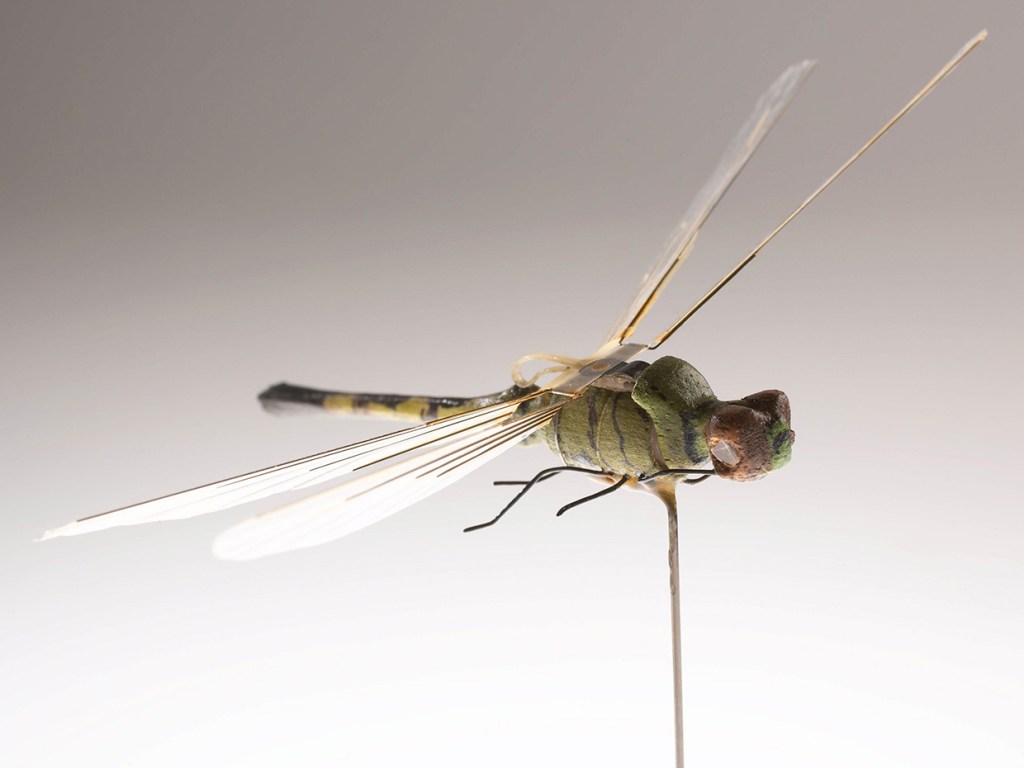
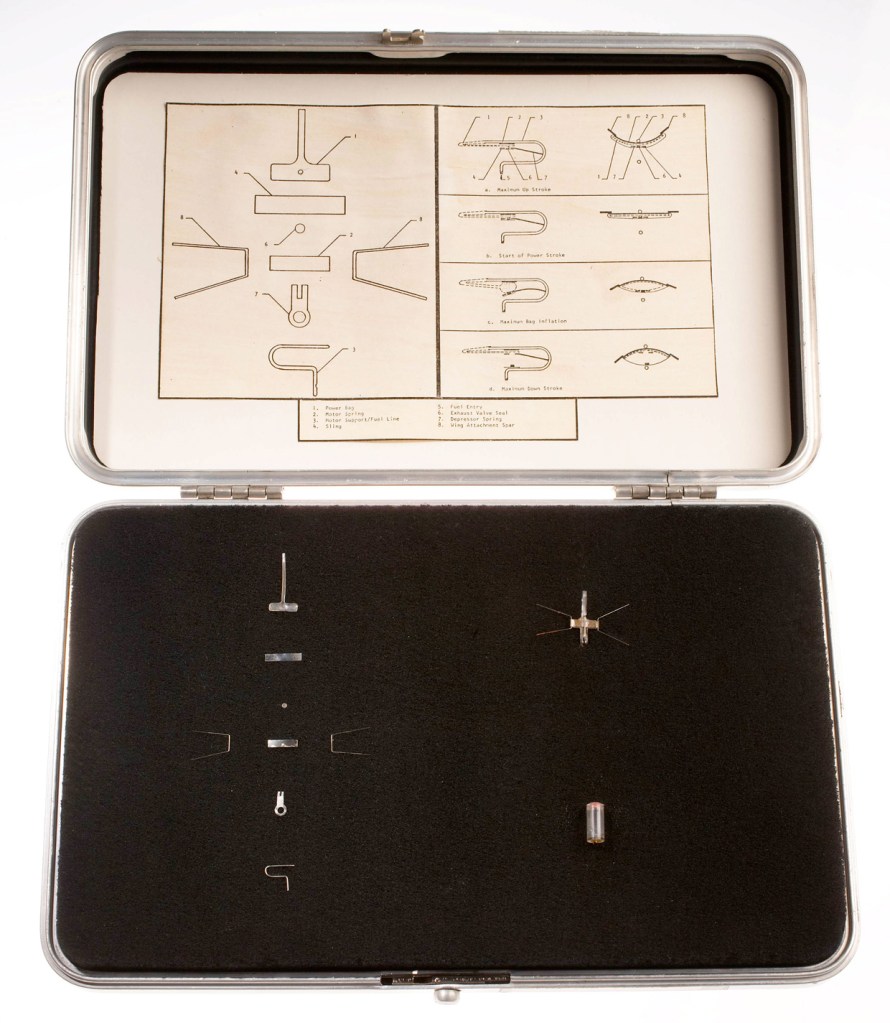
Come to find out, the bugs didn’t fly too well in wind, and due to various performance limitations and manufacturing complications, the program was discontinued. Well, today we have access to better radio-electronic technology, computing and AI (Artificial Intelligence) technology, and materials development technology. Micro-miniaturization has become commonplace.
In 2005, the Netherland’s Delft University of Technology made a DelFly drone that looked like a large dragonfly, and in 2008 made the world’s smallest (publicly recorded) ‘camera plane’. The 3.07 gram, 10 cm insectothopter carried an on-board video camera and vTX (Video Transmitter) to provide ‘live’ in flight video feeds.
The 2007 Wow-Wee FlyTech Dragonfly ‘toy’ became the first commercially-produced bug drone. It didn’t have a camera or anything, but still sold like hotcakes, and was considered one of the best inventions of 2007.
So what’s to stop us (I mean, the CIA or DJI) from making legit bug drones? Some say nothing, and the issue is already an accomplished fact. The unverified photo of a mosquito drone (or MAV, to be precise) and the rumors it has capability for not only monitoring, but also DNA-sampling or (more sinister) implantation of RFID (Radio Frequency Identification) micro-chips through a ‘mosquito bite’. Who’d have ever thought unwanted drone bites would become one of our modern-day concerns?
Well, the future is here – and it might just bite you…or monitor you…or implant you. Replacing the beauty and fascination of nature, in the future when we see a bird soaring, we won’t think of beauty, but instead wonder if it’s the CIA or China spying on us. When a mosquito bites us, we won’t worry we’ll get the West Nile Virus – we’ll worry we’ve been implanted with some nefarious nano-technology.
Yes, the future is here…and it comes in the form of bug drones and bird drones.

My question is…when can we buy them? Can we hook FPV (First-Person View) goggles up to them? Will they even need Remote ID and Tracking…or could you even track non-complaint bugs which weren’t equipped with that (voluntary) mass surveillance technology? When will they appear on Amazon? After all, at the turn of the century the type of drones we had today existed only in the imagination (and research labs) of very few scientists.
Yes, the future is upon us…and it is cool…and a little creepy.
Post Script: To some, it makes no sense to re-invent the wheel. Why not just strap a controller and flight package on a real dragonfly and use it? According to IEEE Spectrum, Researchers at Draper, in Cambridge, Mass., and the Howard Hughes Medical Institute at Janelia Farm are genetically modifying real dragonflies so that their nervous systems respond to pulses of light, and then equipping the insects with a backpack of electronics. The cybernetic MAV is called DragonflEye.”
P.P.S: Referenced in this article, and of interest to those wishing to understand developing technologies and associated issues, the IEEE (Institute of Electrical and Electronic Engineers) magazine ‘Spectrum’ is always a good read. The article I referenced is here: https://spectrum.ieee.org/tech-history/heroic-failures/meet-the-cias-insectothopter

